Scientific article · Sources checked 2026-10-21
Retinol at a Mean Age of 87: What a 24-Week Arm Study Shows About a Specific Lotion
A small randomized trial found better fine-wrinkle scores with 0.4% retinol than with its lotion base. Its strongest lesson is product-specific: visible improvement, biopsy signals, and prescription-label evidence answer different questions.
Public-source editorial review. No clinician sign-off, firsthand test, personal prescription assessment or supplied-package inspection claimed.
A 2007 study of 36 older adults offers an unusually direct look at retinol and naturally aged skin. Participants had a mean age of 87 and lived in two senior citizen facilities. For 24 weeks, study personnel applied a 0.4% retinol lotion to one arm and the matching vehicle—the lotion base without retinol—to the other. Fine-wrinkle scores improved more on the retinol-treated side. That finding is meaningful, but it is not a percentage reduction in wrinkles, a test of facial use, or proof that every retail retinol preparation produces the same result.
The preparation-record perspective matters here: the ingredient, concentration, base, application conditions, and measured outcome belong together. This analysis uses the indexed primary report abstracts for the retinol and comparison trials, plus the available official RENOVA labeling; it does not treat inaccessible protocol details as established facts. Reading those records together separates three often-blended claims: a clinical change in skin appearance, a biological signal in a few biopsy samples, and evidence supporting a particular prescription cream.
Read through the preparation
Study facts at a glance
Population and design: Thirty-six adults, mean age 87, participated in a randomized, double-blind comparison of retinol and vehicle on opposite arms. Source 1
Studied preparation: Study personnel applied topical 0.4% retinol lotion or vehicle up to three times weekly for 24 weeks; this describes the trial, not a general-use schedule. Source 1
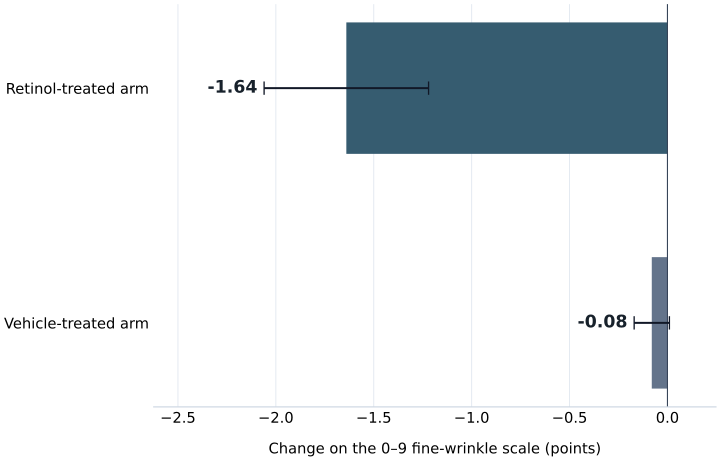
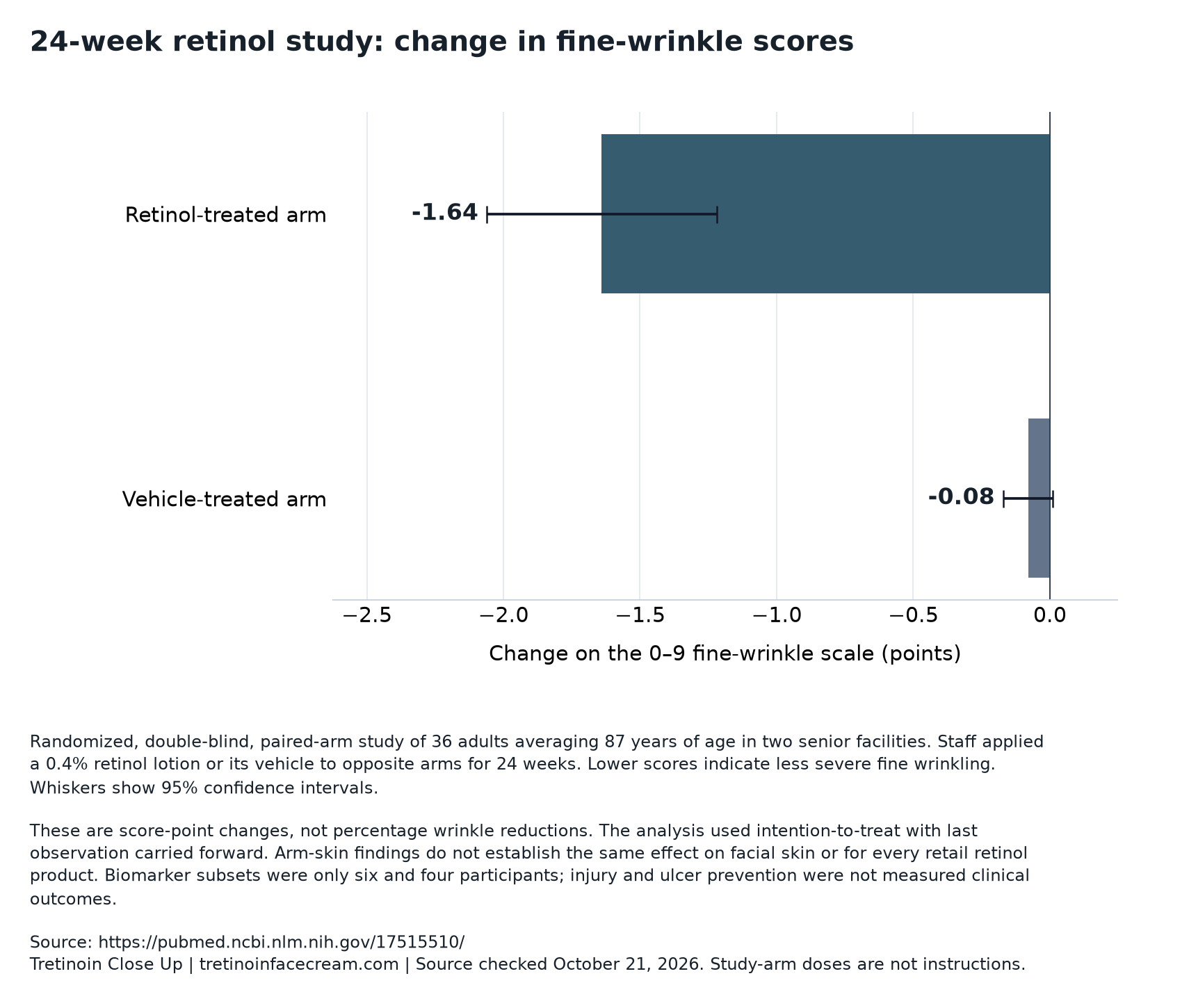
Fine-wrinkle result: Mean score changes were −1.64 with retinol and −0.08 with vehicle on a 0–9 severity scale. The respective 95% confidence intervals were −2.06 to −1.22 and −0.17 to 0.01. Source 1
Small biopsy subsets: Glycosaminoglycan expression was evaluated in six participants and procollagen I immunostaining in four—not in all 36 participants. Source 1
Separate prescription evidence: RENOVA 0.02% labeling concerns that tretinoin cream and fine facial wrinkles; it does not establish the performance of over-the-counter retinol lotions. Source 2
Opposite arms made each participant a comparison
The retinol trial used a randomized, double-blind, vehicle-controlled, left-versus-right-arm design. Each participant received the active preparation and the comparison preparation on different arms. Randomization assigned treatment sides, while blinding was intended to limit expectations influencing treatment or assessment. The abstract identifies an academic referral-center setting and residents of two senior citizen facilities.
This within-person design has a useful advantage: age, many health characteristics, and much of a participant’s lifetime environment are shared between the two treatment sites. A comparison between arms therefore avoids some variation that would arise if one group of people received retinol and a separate group received vehicle. It does not make the two arms biologically identical, but it strengthens the local treatment comparison.
The sample remains 36 people, not 72 independent participants. Two treated arms provide paired observations within individuals. The distinctive age distribution makes the study particularly relevant to an underrepresented population, while the small sample and two-facility recruitment limit how confidently it represents all older adults, other living arrangements, or younger users.
Read the underlying chart data: download CSV or download the source-labeled chart.
The intervention was a lotion under staff-controlled conditions
The active intervention was topical 0.4% retinol lotion, applied by study personnel at visits up to three times a week over 24 weeks. Those details identify the experimental exposure. They do not establish an optimal routine, the amount applied at every visit, or a schedule appropriate outside the trial. The abstract does not provide enough information to reconstruct the complete preparation or application record.
The vehicle was an important comparator rather than an absence of care. Comparing retinol lotion against its base asks whether including retinol produces an additional effect under the study conditions. It does not compare the finished lotion with untreated skin, and it does not isolate how the same retinol concentration would behave in a different base.
Concentration describes how much active ingredient is present; formulation describes the preparation carrying it. The distinction is developed in the guide to strength and vehicle. Here, the evidence belongs to the tested lotion-plus-application conditions. A matching percentage on another bottle is not a record demonstrating matching clinical performance.
A 1.64-point change is not a 64% wrinkle reduction
Clinical assessment used a semiquantitative severity scale running from 0, meaning none, to 9, meaning most severe. Semiquantitative means that an observer assigns an ordered score rather than measuring wrinkles in a physical unit such as millimeters. Lower scores represented less severe wrinkling. At 24 weeks, the reported fine-wrinkle change was −1.64 with retinol versus −0.08 with vehicle.
Subtracting the reported changes gives a descriptive separation of 1.56 scale points in favor of retinol. That is original arithmetic from the reported estimates, not a separately reported effect estimate with its own confidence interval. The trial reported P<.001 for the treatment difference, supporting a statistical distinction under its analysis.
The −1.64 figure is neither a 64% reduction nor a 1.64-percentage-point change. Calculating a relative percentage would require an appropriate denominator, including baseline information absent from the abstract, and a severity scale does not automatically support ratio interpretations. The abstract also does not establish what score difference participants would consider personally important.
Reading the fine-wrinkle numbers without changing their units
| Reported measure | Result | Appropriate interpretation |
|---|---|---|
| Retinol score change | −1.64; 95% CI −2.06 to −1.22 | An average decrease in observer-rated severity |
| Vehicle score change | −0.08; 95% CI −0.17 to 0.01 | A small estimated change; the interval includes zero |
| Difference between reported changes | 1.56 points favoring retinol | Descriptive subtraction, not a reported percentage or confidence interval |
| Treatment comparison | P<.001 | Statistical evidence of a difference, not a measure of its practical importance |
Confidence intervals and carried-forward observations answer different questions
The retinol change had a 95% confidence interval from −2.06 to −1.22; the vehicle interval ran from −0.17 to 0.01. These intervals describe uncertainty around the estimated changes under the analysis assumptions. They are not ranges showing how every participant responded. Individual responses could differ substantially from the average without contradicting either interval.
The report specifies an intent-to-treat analysis using last observation carried forward. Intent-to-treat generally aims to preserve the comparison established by randomization. Last observation carried forward fills a missing later measurement with that participant’s most recent available measurement. Its presence in the methods does not mean everyone completed every visit or that there was no attrition.
Carrying a score forward effectively treats it as unchanged after its last observation. That can misrepresent outcomes if participants would otherwise have improved or worsened. The abstract does not give the number of missing observations, their timing, reasons for withdrawal, or alternative missing-data analyses. Those omissions prevent judging how sensitive the final estimate was to this assumption.
Biopsies supplied biological clues in very small subsets
The investigators also examined biopsy specimens from treated areas. Retinol was associated with greater glycosaminoglycan expression than vehicle in a subgroup of six participants, with P=.02. Glycosaminoglycans are components of the tissue environment that can retain water. Their measurement offers a plausible biological connection to changes in skin appearance, but it is not itself a clinical wrinkle score.
Procollagen I immunostaining increased relative to vehicle in four participants, with P=.049. Immunostaining uses antibody-based detection to assess a tissue marker; procollagen is a precursor involved in collagen formation. The abstract provides no percentage increase, confidence interval, or sufficiently detailed magnitude for either biopsy result. Statistical significance cannot supply those missing quantities.
These subsets should not be described as findings in all 36 participants. Nor does increased staining directly quantify total mature collagen, tissue strength, or durability of the visible effect. The authors proposed greater matrix synthesis as an explanation for improvement. That interpretation is biologically suggestive, but the clinical and biopsy results do not establish a complete causal pathway.
Injury resistance was a hypothesis, not a measured benefit
The authors extended their tissue interpretation to suggest that retinol-treated aged skin might better withstand injury and ulcer formation. That is a hypothesis arising from the matrix findings, not a reported demonstration of ulcer prevention. The abstract reports clinical appearance and biochemical measurements, not an endpoint counting wounds, ulcers, skin tears, or healing events.
The distinction is consequential. A tissue marker may move in a favorable direction without producing enough structural change to prevent injury in everyday conditions. Demonstrating that clinical benefit would require appropriate injury-related outcomes, sufficient follow-up, and a study able to distinguish treatment effects from other determinants of skin damage.
For the same reason, this study does not establish fewer infections, reduced care needs, or better quality of life. Those outcomes would matter greatly in very old adults, but they are not substitutes for the measured fine-wrinkle result. The unresolved scientific question is whether the observed tissue signals translate into durable functional benefits, not merely whether those benefits sound plausible.
Tolerability cannot be reconstructed from the retinol abstract
The indexed retinol abstract does not provide full adverse-event counts, irritation severity, or discontinuation reasons. It therefore cannot support statements that all participants tolerated treatment, that irritation never occurred, or that the lotion was risk-free. Staff application documents who administered the preparation; it does not by itself establish comfort or complete adherence.
Separate tretinoin evidence illustrates why tolerability deserves its own measurement. In a 48-week double-blind study, 99 photoaged patients completed treatment with daily topical 0.1% tretinoin cream, 0.025% tretinoin cream, or vehicle. Both active concentrations improved facial photoaging relative to vehicle, without a clinically or statistically significant efficacy difference between them. Redness and scaling were significantly greater with 0.1%.
That result separates irritation from benefit in that experiment: greater irritation did not correspond to greater observed efficacy. The close reading of the concentration trial explores the comparison further. It cannot supply missing retinol safety rates or establish that retinol and tretinoin have equivalent tolerability.
Longer tretinoin trials broaden context without ranking retinoids
Retinol is not tretinoin, which is all-trans-retinoic acid. Comparing their printed percentages does not create a potency conversion. The 48-week concentration trial studied facial photoaging, whereas the 24-week retinol trial studied naturally aged arm skin in adults averaging 87. Different molecules, locations, populations, durations, and outcome assessments prevent a head-to-head efficacy ranking.
The concentration study also reported similar tissue changes with the two tretinoin strengths: epidermal thickening of 30% and 28%, versus an 11% decrease with vehicle, and vascularity increases of 100% and 89%, versus a 9% decrease. These are measurements of tissue features, not percentage improvements in visible wrinkles. No significant treatment-versus-vehicle changes were found in the assessed immunologic markers.
A separate two-year trial treated 204 participants with topical tretinoin emollient cream 0.05% or vehicle on the entire face once daily. It reported greater improvement in several photodamage signs and increased procollagen synthesis marker staining at month 12. Histologic evaluation found no increase relative to vehicle in the specified atypia, elastosis, or adverse stratum-corneum findings. Those observations do not establish identical effects for other preparations or provide the missing retinol safety counts.
Three trials addressing different treatment questions
| Study | Population and exposure | Main interpretive boundary |
|---|---|---|
| 24-week retinol trial | 36 adults, mean age 87; 0.4% lotion versus vehicle on opposite arms | Naturally aged arm skin; small biopsy subsets |
| 48-week tretinoin comparison | 99 completers; facial photoaging; 0.1%, 0.025%, or vehicle cream daily | Strength comparison within one drug, not a retinol conversion |
| Two-year tretinoin trial | 204 participants; moderate to severe facial photodamage; 0.05% emollient cream or vehicle daily | Longer product-specific clinical and histologic evidence |
RENOVA labeling has its own population and safety record
The official RENOVA 0.02% label concerns a specific oil-in-water tretinoin cream, used as an adjunct to comprehensive skin care and sunlight avoidance for mitigation of fine facial wrinkles. It does not claim elimination of wrinkles or restoration of younger skin. Its indication should not be expanded using outcomes from another strength, another formulation, or the retinol arm trial.
The label provides concrete safety findings absent from the retinol abstract. Among 339 patients applying RENOVA 0.02% in double-blind, vehicle-controlled studies, almost all reported at least one local reaction, such as peeling, dryness, burning, stinging, redness, or itching. It reports a 32% category combining severe irritation, temporary discontinuation, or use of a mild topical corticosteroid; about 4% discontinued because of adverse reactions. These figures describe RENOVA, not retinol.
Age coverage also differs. The label discusses patients aged 65–71 and states that safety and effectiveness above 71 have not been established for RENOVA 0.02%. A retinol trial with a mean age of 87 does not fill that product-specific gap. Likewise, the separate two-year 0.05% trial does not erase the 0.02% label’s duration-specific limitations.
Preparation records keep the evidence attached to the product
The retinol finding supports a specific experimental preparation, not all over-the-counter retinol products. The abstract does not establish interchangeability across creams, serums, combined actives, containers, or storage histories. A useful documentary starting point is the dispensing-record guide, with separate questions about containers, dates, and storage. Those records identify a preparation; they do not themselves prove equivalent efficacy.
Editorial interpretation: when comparing a commercial service with published research, the first question is whether the product can be identified precisely enough to make the comparison meaningful. Readers checking documentary terms can consult the Agency preparation review or Hers preparation review. These links are not evidence that either service supplies the studied lotion, treats this population, or reproduces trial outcomes.
The indexed trial abstracts do not identify sponsors or funding arrangements, so sponsorship cannot be reliably assigned here. RENOVA’s label identifies Bausch Health entities as distributor and manufacturer, which is a different kind of record. Across these documents, the strongest conclusion remains narrow but useful: the tested retinol lotion improved observer-rated fine wrinkles over vehicle under controlled conditions, while formulation transfer, longer-term tolerability, and functional skin benefits remain unresolved.
Questions about the evidence
Does the study show that retinol works in very old adults?
It provides randomized evidence of improved fine-wrinkle scores on treated arm skin in a small group whose mean age was 87. That is more direct evidence for this age group than extrapolating entirely from younger adults. It still does not establish response in every very old adult, facial effectiveness, or benefits beyond the measured appearance outcome.
Why is the vehicle comparison more informative than a before-and-after photograph?
A before-and-after change can reflect the lotion base, time, assessment variation, and the active ingredient together. The opposite-arm vehicle comparison helps isolate the added contribution of retinol within the tested formulation. It does not prove that the base was irrelevant or that another base carrying the same concentration would perform identically.
Do the biopsy results prove that retinol rebuilt collagen?
They show increased procollagen I immunostaining in four participants, a signal related to collagen formation. The abstract does not quantify total mature collagen or establish that this marker caused the wrinkle improvement. The six-person glycosaminoglycan finding is another biological clue, not a substitute for measuring tissue strength or clinical injury prevention.
Can 0.4% retinol be converted into an equivalent tretinoin strength?
Not from these studies. Retinol and tretinoin are different molecules, and none of these trials directly compared the retinol lotion with a tretinoin preparation. Differences in formulation, skin site, population, exposure, and outcome measurement add further barriers. Dividing or comparing the printed percentages would not produce an evidence-based clinical equivalence.
Did the study establish how long the improvement lasts?
The abstract reports the 24-week treatment result, not a post-treatment durability analysis. It therefore does not establish how long improvement persisted after applications ended. Information about loss of some effects after discontinuing RENOVA belongs to that prescription cream’s labeling and should not be imported as a measured result for the retinol lotion.
What this evidence supports
The study’s strongest feature is its randomized, blinded, within-person comparison in a notably old population. Its central result is a greater reduction in fine-wrinkle severity with the tested retinol lotion than with vehicle. Small biopsy subsets support biological hypotheses without proving injury resistance or ulcer prevention. For preparation-focused reading, the practical lesson is to keep the molecule, base, exposure, population, and endpoint attached to each claim rather than treating a concentration as a transferable promise.
Research access and limitations
This analysis uses indexed primary research abstracts and the available official RENOVA label. Full trial protocols, complete adverse-event tables, baseline score distributions, funding disclosures, and sensitivity analyses were not available in the abstracts. The absence of those details limits reconstruction of the studies; it is not evidence that the investigators failed to collect them.
Sources for this preparation discussion
- Improvement of naturally aged skin with vitamin A (retinol). ↗Indexed original research abstract · Accessed 2026-10-21
- RENOVA tretinoin cream 0.02% prescribing information ↗Exact drug label; record updated February 24, 2026; internal November 2025 revision, not stock verification · Accessed 2026-10-21
- Two concentrations of topical tretinoin (retinoic acid) cause similar improvement of photoaging but different degrees of irritation. A double-blind, vehicle-controlled comparison of 0.1% and 0.025% tretinoin creams. ↗Indexed original research abstract · Accessed 2026-10-21
- Long-term efficacy and safety of tretinoin emollient cream 0.05% in the treatment of photodamaged facial skin: a two-year, randomized, placebo-controlled trial. ↗Indexed original research abstract · Accessed 2026-10-21